There’s a debate among psychologists about what emotions are. Yes, that’s right, scientists still do not agree on the nature of emotion, a pretty fundamental part of human experience. Some say that emotions are sharply-defined types – each experience of joy is similar to the next but different from experiences of anger, so that the two emotions are distinguishable.
Others say that the lines between emotions like joy and anger are much more blurry. Each experience of joy is unique – it is accompanied by a unique set of bodily feelings and is shaped by the current situation. And one experience of joy may share some similarities with an experience of anger.
Our new study supports the view that emotions are blurry categories (or ‘populations of instances’). But, more than that, our study nicely illustrates just how fundamental this debate is to emotion science. To study emotions as blurry categories, scientists need to take an entirely different approach, one that allows a participant’s experience to vary naturally in the complex environments of daily life.


To illustrate the variability and complexity of emotions in everyday life, let’s imagine the following scenarios. You are sprawled on the beach under the sun, enjoying a well-earned moment of relaxation with family. Your heart beats slowly as you breathe deeply.
Your vacation has ended and you now find yourself racing through your neighborhood park, propelled by the chorus of footsteps made by your friendly running group. Your heart pounds in your chest.
In each of these scenarios, as in every experience in your daily life, your brain is taking in a wide array of sensory information – the sights and sounds of the people around you, the muscular movements of your activity (lying on the beach or running through the park), your heart pumping blood throughout your body, and so on. From this information, your brain makes meaning.
Emotion is one type of meaning made by your brain, and in each of these scenarios your brain might make the same meaning: joy. The scenarios are not entirely similar – they feature somewhat similar social contexts but different postures, muscular activity, and heart sensations. Each experience is unique, yet the meaning made by your brain is the same (or at least very similar). The category of joy is blurry. This blurriness all happens from the perspective of just one person (you), so this is one type of ‘within-person variability.’
You may have already recognized that the category of joy can also be blurry between people. Maybe you don’t enjoy running. But you know someone who does. In other words, two people can experience similar sensations (those associated with running) but their brains make different meaning. This is one type of ‘between-person variability.’
Most psychological studies try to constrain within-person and between-person variability. Participants in most studies sit in chairs (constraining movement), view a particular set of images on a computer screen (constraining sensory information), while alone (constraining the social context), and report their emotional experience from a set of multiple choice options (constraining the types of meaning the participant can make).
Clearly, studying emotions as blurry categories will require a different approach that places fewer constraints on natural variability. What if we moved the study outside the lab, allowed the person to go about their routine daily life, and asked them to describe their experience during emotionally evocative moments?
Well, our new study did just that.
For 8 hours per day for 14 days, participants wore heart monitors and went about their normal routine. Whenever the person was physically still and experienced a change in heart rate, they received a survey on their phone. The survey asked them what emotions they were feeling and allowed them to write in their own responses. The survey also asked them whether they were alone or with other people (the social context), what they were doing (their primary activity), how pleasant they were feeling (this is called ‘valence’), and how energized they were feeling (this is called ‘arousal’).
Notice that we’re sampling natural moments – specifically those moments when a change in heart right might reflect a change in emotional state. This is a more targeted way of sampling emotional events than, say, if we were to sample events randomly.
Ninety-seven young adults (age 18-36 years) completed the study, providing data for more than 10,000 daily life events (69-197 events per person).
Our first goal was to identify patterns of similar events for each person. (Later on, we’ll see how each person mapped these patterns to emotion labels.) We took the heart data, valence, arousal, posture, activity, and social context recorded for each event, and ran these data points through a modeling algorithm designed to identify patterns (or clusters).
Take Participant #1, displayed in the figure below, who recorded 97 daily life events. Our modeling algorithm identified three unique patterns of daily life experience for this person. The first pattern (labeled Pattern A), included events that tended to be pleasant (positive valence) with moderate arousal, and with minor changes in heart activity (captured by six measures of the timing of heart events and of the blood volume circulating through the body; these are abbreviated in the plot as RSA, IBI, PEP, LVET, SV, and CO). You can see this in the radar plot on the left, where the second ring represents 0, values outside of that ring are positive, values inside the ring are negative, the dark red line represents the average, and the light red lines represent the variance. In Pattern A, Participant #1 was usually sitting, doing leisure activities (though not always), in both social and non-social settings. In Pattern B, Participant #1 was often feeling pleasant with moderate arousal, sitting, doing leisure activities or using the computer, while alone, with increased RSA and IBI (slower heart rate). In Pattern C, Participant #1 was often feeling pleasant with moderate arousal, sitting, doing leisure activities, in both social and non-social settings, and with a decrease in several heart measures (RSA, LVET, SV, and CO, with more variability around these average changes).
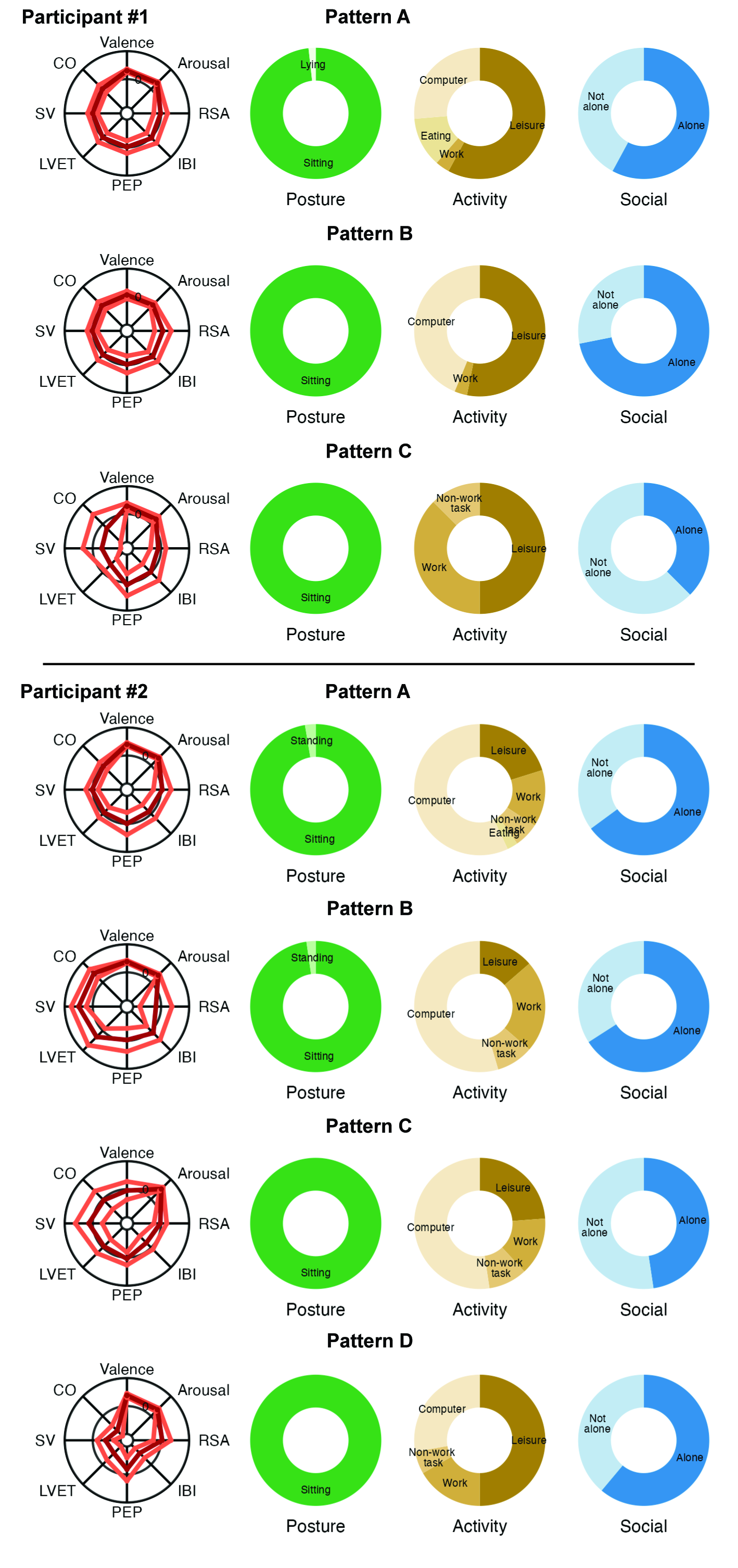
To reiterate, we have identified patterns of experience that recurred in Participant #1’s daily life reliably. Yet, even within these reliable patterns, there was within-person variability.
Compare these patterns to Participant #2 in the above plot, who recorded 197 daily life events that formed four reliable patterns. You can find additional example participants here.
The number and nature of these daily life patterns varied across people (between-person variability). Participants had anywhere from one pattern (suggesting either that the events were all alike or all unique) to six patterns. Most of the patterns (81.7%) were unique to one participant – that is, the patterns were not displayed by two or more people.
Now that we had identified reliable patterns of daily life experience for each person, our second goal was to assess how each person described those patterns using emotion labels. Remember that participants did not explicitly know which event was in which pattern.
Again, take Participant #1, displayed in the figure below, who used 25 different emotion words over the course of the study. Below, the size of the black dot represents the number of times (events) the person used the emotion label in each pattern. In support of the blurry categories view of emotions, Participant #1 used the same emotion word (for example, happy) to describe events in all three patterns. But notice that Participant #1 also used many different emotion words (happy, bored, neutral, relieved, anxious) to describe events in the same pattern (Pattern A). This is within-person variability. Participant #1 made the same meaning out of different experiences, and made different meanings out of similar experiences.
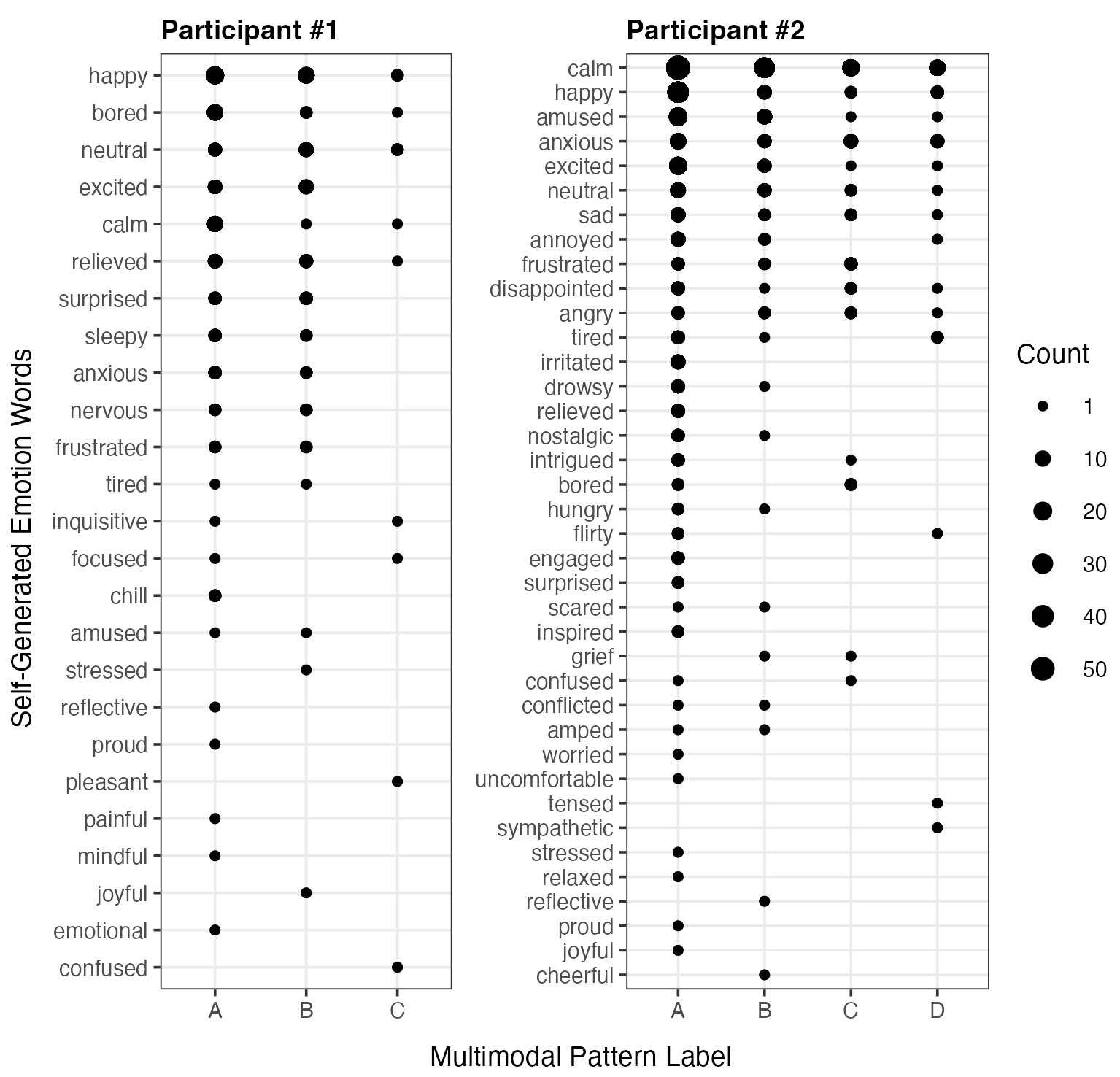
Compare this to Participant #2, who used 38 different emotion words throughout the study. Again, Participant #2 made the same meaning out of different experiences, and made different meanings out of similar experiences. Because Participant #2’s patterns differed from Participant #1’s patterns, this is an example of between-person variability.
Let’s quickly consider what these data would have looked like if emotions were sharply-defined types. The patterns themselves may have been more uniform, they would have recurred across most people, and each person would have reliably assigned exactly one emotion label to each pattern. This is the idea that emotions are hard-wired and universal, that all humans experience the same basic emotions and that these basic emotions feature sharply-defined bodily states. Our data do not support this idea.
Instead, our data suggest that emotions are blurry categories. An emotion label like ‘joy’ is a meaning that the brain makes in the moment based on a wide array of sensory information. For an emotion like joy, the sensory array is not uniform across events – each experience is relatively unique, sharing some but not all similarities to other joyful events.
As scientists, our job may be to better understand the variability of daily life emotional experiences and the brain’s meaning-making process. To capture this variability, studies must allow participants to experience a range of complex situations ‘in the wild’ and to describe their experiences in their own words.
Our approach – built from a sampling method pioneered in our lab five years ago, with new modeling advances – is a powerful tool for capturing the complexity of emotional experience.
Read the paper here. Note that this paper has not been peer reviewed.
Deming, P., Khan, Z., Hoemann, K., Marino, L., Runyun, Ş.L., Kross, Z., Gao, Y., Cory, L., Nielson, C., Feldman, M.J., Devlin, M., Dy, J., Barrett, L.F., Wormwood, J.B., & Quigley, K.S. (2025). Structured variation in daily life experience within and across individuals. PsyArXiv.